
Wayne State UniversityJames and Patricia AndersonCollege of Engineering
Arava Research GroupElectrochemistry · Nanomaterials · Energy Storage

Welcome to Arava Research Group

Arava Research Group studies the fundamental electrochemical principles behind batteries, supercapacitors, and fuel cells.

We design nanomaterials and investigate their transport, electrode kinetics, and stability under extreme conditions. Our work connects materials and interfaces with safer, higher-performance energy systems.

From high-temperature batteries and electric vehicles to micro-sensors and wearable devices, we investigate how materials and interfaces enable new energy technologies.

Explore our research
127+journal articles
18,144+citationsGoogle Scholar
58+h-indexGoogle Scholar
22+patents and applications9 granted US patents

Latest research

All publications →
Cell Reports Physical Science · 2025

Investigation of electrode–electrolyte interfaces to enable non-flammable Li-ion batteries operating up to 125 °C with liquid electrolyte

Sudhan Nagarajan, Sooyeon Hwang, Cherno Jaye, Conan Weiland, Debora Motta Meira, Mahalingam Balasubramanian, Leela Mohana Reddy Arava

Abstract

Non-flammable and high-temperature stable ionic liquid (IL)-based electrolytes could eliminate catastrophic battery failures and improve battery safety, but their poor electrochemical interaction with the LiNi x Mn y Co z O 2 (NMC) family of cathodes is a long-standing problem due to severe parasitic reactions at high temperature.
ACS Applied Energy Materials · 2025

A boron-based anion-receptor additive for high-loading lithium–sulfur batteries under lean electrolyte conditions

Veka Sri Ganesan, Sudhan Nagarajan, Leela Mohana Reddy Arava

Abstract

Although Li–S batteries offer significant promise as replacements for conventional lithium-ion batteries in terms of sustainability and performance, their practical implementation remains challenging. Designing cathodes with high sulfur loading (≥5 mg/cm 2 ) under lean electrolyte conditions (E/S ≤ 5 μL/mg) presents specific obstacles, including sluggish reaction kinetics, poor sulfur utilization, and increased interfacial …

Chemistry of Materials · 2024

Unleashing the potential of fast charging batteries: leveraging anion redox chemistry in Ni- and Co-free cathodes

Sudhan Nagarajan, Subhayan Roychoudhury, Conan Weiland, Debora Motta Meira, Mahalingam Balasubramanian, David Prendergast, Sooyeon Hwang, Leela Mohana Reddy Arava

Abstract

Designing Li-ion battery cathodes free of critical raw materials such as Co and Ni has a huge technological and societal impact. Although anion redox-based Li-rich oxide cathodes allow for designing Co- and Ni-free cathode compositions, the Li-rich oxides demonstrated voltage fade, voltage hysteresis, and irreversible oxygen release despite their high capacity.

Small · 2023

Regulating Li-ion transport through ultrathin molecular membrane to enable high-performance all-solid-state battery

Sathish Rajendran, Antony George, Zian Tang, Christof Neumann, Andrey Turchanin, Leela Mohana Reddy Arava

Abstract

Solid‐state lithium metal batteries with garnet‐type electrolyte provide several advantages over conventional lithium‐ion batteries, especially for safety and energy density. However, a few grand challenges such as the propagation of Li dendrites, poor interfacial contact between the solid electrolyte and the electrodes, and formation of lithium carbonate during ambient exposure over the solid‐state electrolyte prevent the …

Chemistry of Materials · 2022

Depth-dependent understanding of cathode electrolyte interphase (CEI) on layered Li-ion cathodes operated at extreme high temperature

Sudhan Nagarajan, Conan Weiland, Sooyeon Hwang, Mahalingam Balasubramanian, Leela Mohana Reddy Arava

Abstract

The high-temperature operation of Li-ion batteries is highly dependent on the stability of the cathode electrolyte interphase (CEI) formed during lithiation–delithiation reactions. However, knowledge on the nature of the CEI is limited and its stability under extreme temperatures is not well understood.

ACS Applied Materials & Interfaces · 2022

Unveiling the electrocatalytic activity of 1T′-MoSe₂ on lithium-polysulfide conversion reactions

Kiran Mahankali, Sundeep Varma Gottumukkala, Nirul Masurkar, Naresh Kumar Thangavel, Rahul Jayan, Abdulrazzag Sawas, Sudhan Nagarajan, Md Mahbubul Islam, Leela Mohana Reddy Arava

Abstract

The dissolution of intermediate lithium polysulfides (LiPS) into an electrolyte and their shuttling between the electrodes have been the primary bottlenecks for the commercialization of high-energy density lithium–sulfur (Li–S) batteries. While several two-dimensional (2D) materials have been deployed in recent years to mitigate these issues, their activity is strictly restricted to their edge-plane-based active sites.

Journal of the American Chemical Society · 2021

Mixed cationic and anionic redox in Ni and Co free chalcogen-based cathode chemistry for Li-ion batteries

Sudhan Nagarajan, Sooyeon Hwang, Mahalingam Balasubramanian, Naresh Kumar Thangavel, Leela Mohana Reddy Arava

Abstract

Mixed cationic and anionic redox cathode chemistry is emerging as the conventional cationic redox centers of transition-metal-based layered oxides are reaching their theoretical capacity limit. However, these anionic redox reactions in transition metal oxide-based cathodes attained by taking excess lithium ions have resulted in stability issues due to weak metal–oxygen ligand covalency.

Chemistry of Materials · 2021

An all-solid-state battery with a tailored electrode–electrolyte interface using surface chemistry and interlayer-based approaches

Sathish Rajendran, Aparna Pilli, Olatomide Omolere, Jeffry Kelber, Leela Mohana Reddy Arava

Abstract

Major challenges in the development of solid-state batteries using garnet-type solid-state electrolytes (SSEs) include suppressing dendrite growth, improving moisture stability, and reducing interfacial resistance. Prior attempts to remove surface impurities of SSEs through dry polishing caused high interfacial resistance that proves this method to be unviable.

Advanced Energy Materials · 2021

Inhibition of lithium dendrite formation in lithium metal batteries via regulated cation transport through ultrathin sub-nanometer porous carbon nanomembranes

Sathish Rajendran, Zian Tang, Antony George, Andrew Cannon, Christof Neumann, Abdulrazzag Sawas, Emily Ryan, Andrey Turchanin, Leela Mohana Reddy Arava

Abstract

Suppressing Li dendrite growth has gained research interest due to the high theoretical capacity of Li metal anodes. Traditional Celgard membranes which are currently used in Li metal batteries fall short in achieving uniform Li flux at the electrode/electrolyte interface due to their inherent irregular pore sizes.

Nano Letters · 2021

Light-assisted rechargeable lithium batteries: organic molecules for simultaneous energy harvesting and storage

Keiko Kato, Anand B. Puthirath, Ali Mojibpour, Mikhail Miroshnikov, Sitakanta Satapathy, Naresh Kumar Thangavel, Kiran Mahankali, Liangliang Dong, Leela Mohana Reddy Arava, George John, Palash Bharadwaj, Ganguli Babu, Pulickel M. Ajayan

Abstract

Lithium batteries that could be charged on exposure to sunlight will bring exciting new energy storage technologies. Here, we report a photorechargeable lithium battery employing nature-derived organic molecules as a photoactive and lithium storage electrode material. By absorbing sunlight of a desired frequency, lithiated tetrakislawsone electrodes generate electron-hole pairs.

ACS Applied Materials & Interfaces · 2020

Atomically engineered transition metal dichalcogenides for liquid polysulfide adsorption and their effective conversion in Li-S batteries

Kiran Mahankali, Naresh Kumar Thangavel, Daryna Gopchenko, Leela Mohana Reddy Arava

Abstract

Curtailing the polysulfide shuttle by anchoring the intermediate lithium polysulfides (LiPS) within the electrode structure is essential to impede the rapid capacity fade in lithium-sulfur (Li-S) batteries. While most of the contemporary Li-S cathode surfaces are capable of entrapping certain LiPS, developing a unique electrode material that can adsorb all the intermediates of sulfur redox is imperative.

ACS Applied Materials & Interfaces · 2020

Tri-doped BaCeO₃–BaZrO₃ as a chemically stable electrolyte with high proton-conductivity for intermediate temperature solid oxide electrolysis cells (SOECs)

Sathish Rajendran, Naresh Kumar Thangavel, Hanping Ding, Yi Ding, Dong Ding, Leela Mohana Reddy Arava

Abstract

Solid oxide electrolysis cells (SOECs) are devices that enable economically viable production of clean fuel such as hydrogen gas, which can be used in many industrial applications and serving as an energy carrier for renewable energy sources. Operation of SOEC at intermediate temperature (IT) range (400 to 600 °C) is highly attractive because many unexploited heat sources from industries can be utilized.

Biosensors and Bioelectronics · 2020

Reliable and highly sensitive biosensor from suspended MoS₂ atomic layer on nano-gap electrodes

Nirul Masurkar, Naresh Kumar Thangavel, Sally Yurgelevic, Sundeep Varma, Gregory W. Auner, Leela Mohana Reddy Arava

Abstract

The uneven morphology and the trapped charges at the surface of the traditionally used supporting substrate-based 2D biosensors produces a scattering effect, which leads to a irregular signals from individually fabricated devices.

Electrochimica Acta · 2019

Electrocatalysis-driven high-energy-density Li-ion polysulfide battery

Abdulrazzag Sawas, Ganguli Babu, Naresh Kumar Thangavel, Leela Mohana Reddy Arava

Abstract

Though carbon-based porous materials have improved lithium-sulfur (Li-S) battery performance remarkably, the poor adsorption of polysulfides and their sluggish reaction kinetics limits them from practical application. On the other hand, the presence of lithium metal especially under the highly reactive polysulfide environment causes safety concerns.

Nano Letters · 2019

In situ electrochemical mapping of lithium–sulfur battery interfaces using AFM–SECM

Kiran Mahankali, Naresh Kumar Thangavel, Leela Mohana Reddy Arava

Abstract

Although lithium–sulfur (Li–S) batteries are explored extensively, several features of the lithium polysulfides (LiPS) redox mechanism at the electrode/electrolyte interface still remain unclear. Though various in situ and ex situ characterization techniques have been deployed in recent years, many spatial aspects related to the local electrochemical phenomena of the Li-S electrode are not elucidated.

Electrochimica Acta · 2019

Interfacial behavior of water-in-salt electrolytes at porous electrodes and its effect on supercapacitor performance

Kiran Mahankali, Naresh Kumar Thangavel, Yi Ding, Susil K. Putatunda, Leela Mohana Reddy Arava

Abstract

Though Water-in-salt (WIS) electrolytes offer a wide potential window for energy storage device operation in aqueous conditions that can deliver high energy density, their high viscosity and low ionic conductivity certainly limits the rate performance of the devices.

Journal of Power Sources · 2018

Millimeter-scale lithium-ion battery packaging for high-temperature sensing applications

Nirul Masurkar, Ganguli Babu, Sanjeev Porchelvan, Leela Mohana Reddy Arava

Abstract

Continuously growing and miniaturizing autonomous electronic devices and sensors for large temperature window is mostly depends on stability and performance of power-up systems. The net achievable power and energy densities of such miniatured rechargeable energy storage systems are largely dominated by internal hardware and external packaging materials.

Carbon · 2017

Lateral heterostructures of two-dimensional materials by electron-beam induced stitching

Andreas Winter, Antony George, Christof Neumann, Zian Tang, Michael J. Mohn, Johannes Biskupek, Nirul Masurkar, Arava Leela Mohana Reddy, Thomas Weimann, Uwe Hübner, Ute Kaiser, Andrey Turchanin

Abstract

We present a novel methodology to synthesize two-dimensional (2D) lateral heterostructures of graphene and MoS2 sheets with molecular carbon nanomembranes (CNMs), which is based on electron beam induced stitching.

Recent publications

All publications →

News & updates

All news →
Fall 2026

Welcome, Vinay Boligarla!

Congratulations and welcome to Vinay Boligarla, who joins the Arava Research Group as a Ph.D. student in Fall 2026. Vinay comes from the National Taiwan University of Science and Technology, with research on fluorine-free (PFAS-free) electrolytes for lithium-metal batteries, and is first author of a 2025 Energy & Environmental Science review on fluorine-free battery electrolytes.

Vinay’s profile →
2026

MoDee Dahdolan, P.E., joins the group

Welcome to MohdEslam (MoDee) Dahdolan, a licensed Professional Engineer in Michigan, who joins the Arava Research Group as a Ph.D. student. MoDee also teaches as a part-time engineering instructor at Wayne State (since January 2026).

MoDee’s profile →
2026

Congratulations, Veka Sri Ganesan: Kummler research award

Wayne State Engineering named Arava group Ph.D. student Veka Sri Ganesan among the recipients of the 2026 Ralph H. Kummler Distinguished Achievement Award for Graduate Student Research. Veka was recognized for dissertation work on advanced electrolytes for high-loading lithium–sulfur batteries under lean-electrolyte conditions, a patent filing on thermally stable electrolytes, and NSF Regional I-Corps participation.

Wayne State Engineering news ↗

Research in focus

Research areas →

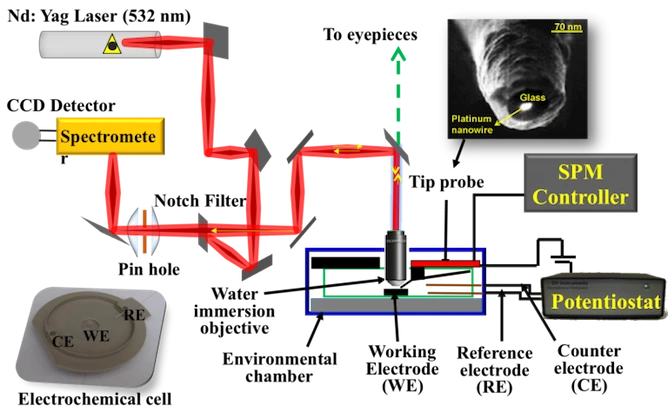
We investigate materials and interfaces across scales, using in situ scanning electrochemical microscopy coupled with Raman spectroscopy to understand electrochemical behavior.

  • Energy storage & conversion
    Batteries, supercapacitors, and fuel cells
  • Nanoscale materials & interfaces
    Transport, kinetics, and stability
  • Flexible & miniaturized devices
    Energy systems for sensors and wearables
In situ scanning electrochemical microscopy coupled with Raman spectroscopy (SECM-Raman) setup
In situ SECM-Raman: watching electrochemistry as it happensResearch →